As part of a multiyear evaluation of the technical assistance and capacity-building services provided by the Western Education Equity Assistance Center (WEEAC), the Utah Education Policy Center has collaborated with WEEAC to develop this impact story. The report highlights the center's sustained technical assistance provided to Nevada's Office of Indian Education, culminating in the development of a 5-year improvement plan to address persistent gaps in educational outcomes among Nevada's American Indian and Alaska Native students.
Reports and Briefs
This study, which was conducted as part of a research practice partnership with the USBE, compares the retention and end-of-year standardized assessment results of newly licensed teachers from the Alternate Pathway to Professional Educator License - Special Education (APPEL-SpEd) pathway to those of newly licensed teachers from traditional university special education programs. Our results indicate no evidence of differences between teachers coming from these two pathways.
In partnership with the Utah State Board of Education (USBE), the Utah Education Policy Center (UEPC) conducted a research study aimed at informing the state's understanding of the vulnerabilities facing both boys and girls in Utah, as well as the supports needed to address these vulnerabilities. Girls tended to have consistently higher high school graduation rates and higher proficiency rates on English Language Arts (ELA) end-of-year assessments than boys, with the ELA gender gap widening at higher grade levels. Boys tended to have higher proficiency rates in math and science. Data from the National Assessment of Educational Progress (NAEP) confirmed these patterns and showed that the gender performing worse in a particular subject in Utah (boys in reading and girls in math) performed similar to or slightly better than the national average, whereas the gender performing better in a particular subject in Utah (girls in reading and boys in math) performed better than the national average. Data from the Student Health and Risk Prevention (SHARP) survey showed that girls reported higher rates of “internalizing” symptoms such as depression, while boys reported higher rates of “externalizing” symptoms such as aggression. Both boys and girls in Utah face meaningful and unique academic and mental health vulnerabilities. However, the sizes of the gender gaps were small compared to the much larger disparities linked to disability status, economic disadvantage, and other student characteristics. Because of these findings, the UEPC recommends solutions with a broad, structural focus rather than those centered on gender.

The Utah Education Policy Center (UEPC) partnered with the Utah State Board of Education (USBE) and Utah Leading through Effective, Actionable, and Dynamic (ULEAD) Education to conduct a mixed-methods study to identify school-level factors contributing to strong post-pandemic student academic recovery among positive outlier schools in Utah. Building on previous USBE-sponsored research, this study examined eight schools across five LEAs that demonstrated strong academic recovery during 2021-22 and 2022-23 through interviews, focus groups, and surveys with school leaders and educators. The analysis presents interrelated key findings and actionable recommendations for school and LEA leaders to advance improvements in student academic recovery across Utah.
This report shares findings from the 2024-25 evaluation of the STEM Action Center’s Professional Learning (PL) Grant program. Educators and site leaders reported stronger STEM teaching skills, greater confidence, and more opportunities for collaboration as a result of their participation. The evaluation also highlights persistent challenges, including limited time and competing priorities, and offers considerations to strengthen future STEM PL efforts.
This report outlines the evaluation of Utah STEM Action Center's Computing Partnership (CP) grant program in their second and final year of implementation during the 2024-25 academic year. Findings from the evaluation highlighted the expansion of computing programming at participating sites and reported growth among students and educators engaged in grant activities, while also noting the need for continued support in rural areas and strategies to better foster students’ computing identities.
The Utah Education Policy Center (UEPC), in collaboration with the Utah State Board of Education (USBE), conducted an evaluation of the Early Interactive Software Program (EISP), a state-supported initiative to strengthen literacy skills among students in grades K-3 through early literacy software. The evaluation focused on both implementation of the program and its impact on reading proficiency.
As part of an ongoing research-practice partnership with the Utah State Board of Education (USBE), the Utah Education Policy Center (UEPC) conducted a study of facilitators and barriers to the representation of students with disabilities in Career and Technical Education (CTE). The study sought to understand how facilitators and barriers differed among exemplar and improvement sites. The findings and recommendations complement the USBE’s 2024-2029 Strategic Plan for Utah’s Secondary Career and Technical Education, which outlines the goals of Awareness and Outreach, Industry Alignment, Postsecondary Alignment, and Durable Skills. In addition, this research supports an understanding of how LEAs are ensuring students with disabilities are aware of and have access to educational opportunities, including those that prepare them for employment or career preparation.
This report provides findings from the Utah Education Policy Center’s 2024-2025 evaluation of STEM Action Center’s AmeriCorps Math Mentors Program for the 2024-2025 school year. The report summarizes results related to program implementation, mentors’ perceptions of training and support, and changes in student attitudes and performance.
This report shares findings from the Utah Education Policy Center’s 2024–2025 evaluation of Volunteer for Good, a four-year pilot program (2024–2028) developed by the Utah Commission on Service and Volunteerism (UServeUtah). The program promotes volunteerism and seeks to strengthen high school students’ well-being, civic engagement, and academic and social success. Operating in five Local Education Agencies (Garfield, Granite, Nebo, and Sevier School Districts, and Mountain Heights Academy), the Year 1 evaluation summarizes key implementation metrics, highlights facilitators and barriers to implementation, and provides preliminary insights into how participation relates to students’ perceptions of social connectedness and emotional well-being.
This report presents findings from an independent evaluation of Beast Academy Online, a digital mathematics learning platform, conducted by the Utah Education Policy Center (UEPC) in partnership with Art of Problem Solving. The findings indicate that regular use of Beast Academy Online supports mathematics achievement for high-ability elementary students, a group often overlooked in remediation-focused recovery efforts. Based on its correlational design with statistical controls for selection bias, this study provides Promising Evidence under ESSA Tier 3.
The Utah Education Policy Center (UEPC), in a research practice partnership with the Utah State Board of Education (USBE), conducted a survey study to examine why preservice teachers in Utah choose careers in special vs. general education, how they perceive the special education teaching profession, and what factors influence these perceptions.
This report provides findings from the Utah Education Policy Center’s 2024-2025 evaluation of STEM Action Center’s K-12 Math Personalized Learning Software Grant Program. Using teacher surveys, student surveys, math learning software (MLS) usage data, and statewide administrative data, the evaluation examined five key evaluation questions related to the quality of MLS implementation, teacher and student perceptions of its value, and the relationship between MLS usage and student math attitudes and achievement.
The Youth Teaching Youth (YTY) program at the Natural History Museum of Utah engages middle school students as science educators for elementary students and provides high school participants with paid internship opportunities. This report presents findings from the Utah Education Policy Center’s evaluation of YTY, examining its impact on three key outcomes: middle school students’ end-of-year science test scores, chronic absenteeism rates, and on-time high school graduation rates.
Using qualitative methods, this study explored how states framed the need for their work, their motivations for implementation efforts and challenges, key partnerships in establishing and implementing the work, perceived impacts, and reflections on lessons learned, missed opportunities, and planned next steps.
The Utah Aspire Plus is an annual assessment of reading, English language arts, math, and science administered to Utah public school students in grades 9 and 10. The Utah State Board of Education contracted with the Utah Education Policy Center to study possible causes of the decline in Utah Aspire Plus participation, including causes related to the “perceived and realized value” of the assessment to students, parents, and educators, and to recommend changes that might improve participation.
The Utah State Board of Education (USBE) partnered with the Utah Education Policy Center (UEPC) to evaluate the predictive validity of the Acadience Reading assessment’s four subscores (Oral Reading Fluency, Accuracy, Retelling, and MAZE), measured in first through third grade, in reference to two subscores on Utah’s third grade RISE Reading assessment: Informational Text and Literature.
This report summarizes findings from UEPC's three-year evaluation of the Pre-Freshman Engingeering Program (PREP) Plus at Salt Lake Community College (SLCC), which was funded by the National Science Foundation (NSF) Advanced Technical Education (ATE) program. PREP Plus focused on the development and implementation of a competency-based engineering technology certificate program at SLCC for high school students from Jordan School District in Utah.
The Beverley Taylor Sorenson Arts Learning Program (BTS Arts) provides arts-integrated instruction to elementary students across the state of Utah. The BTS Arts goal is to improve student outcomes, including in language arts, social studies, mathematics, and science (BTS Handbook, 2023). In September 2023, the University of Utah was awarded grant funding from the Utah State Board of Education to study the implementation practices, outcomes, and barriers to participation in BTS Arts.
In collaboration with the Utah State Board of Education and Ed Direction, a part of MGT of America, LLC, the Utah Education Policy Center evaluated the relationship between schools’ level of participation in the Assessment to Achievement (A2A) project and the end-of-year state achievement test scores of their students.
This report presents findings and considerations from the second year of the UEPC's evaluation of the Institute for Data-Driven Dynamical Design (ID4), funded by the National Science Foundation (NSF) Harnessing the Data Revolution (HDR) program. Led by a team at Colorado School of Mines, ID4 is a virtual institute uniting scholars and students from 12 sites across the country to integrate human and machine intelligence, revolutionize the design cycle, and foster an inclusive scientific community.
The Idaho Out-of-School Network (ION), Idaho Commission for Libraries, and Idaho STEM Action Center formed a unique partnership to support out-of-school time (OST) programs aimed at addressing lost school time and unfinished learning for youth in Idaho. With funding from the ESSER III (Elementary and Secondary School Emergency Relief Fund) grant under the American Rescue Plan, administered by the Idaho State Board of Education, the three agencies coordinated to create and deliver grant programs for various types of OST initiatives. The work was commissioned to assess the value and impact of these programs.
Idaho Out-of-School Network (ION), Idaho Commission for Libraries, and Idaho STEM Action Center coordinated, developed, and delivered grant programs to expand opportunities for a wide range of OST initiatives. This brief summarizes evaluation findings from the Idaho Commission for Libraries’ OST Programs for the 2022-23 School Year.
UEPC’s study compared the reading achievement of a sample of Utah’s FDK and HDK students who started kindergarten between 2015 and 2017. Results highlight the impact of FDK on reading achievement during kindergarten, and suggest a need to provide continued, targeted support to sustain students’ academic progress through third grade.
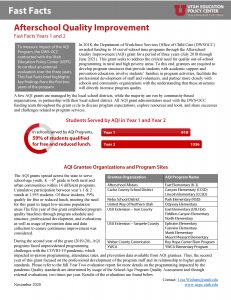
The Idaho Out-of-School Network (ION) contracted the Utah Education Policy Center to evaluate the Idaho Community Programs for Youth (ICPfY) grant. The grant aimed to enhance out-of-school programs by improving access, quality, and equity, with a focus on academic and social-emotional learning for students most affected by the COVID-19 pandemic.
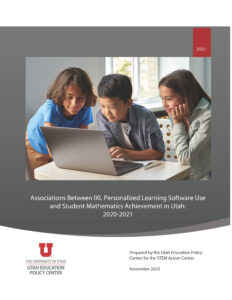
This report was prepared for the STEM Action Center in support of the K-12 Math Personalized Learning Software Grant Program. The results of this quasi-experimental study suggest that Utah students who, on average, used IXL for 20 minutes or more per week in 2020-2021 performed better on statewide math assessments than students who did not use IXL. This finding is consistent with IXL’s implementation fidelity and usage recommendations which indicate that, for “optimal usage,” students should reach proficiency in at least two skills per week.
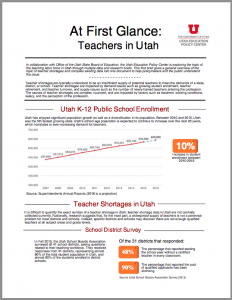
The STEM AC 2021-2022 Professional Learning grant (PL) supports schools and districts through awarding one to three-year grants to support STEM learning, STEM professional development, and STEM-related needs. Since 2016, UEPC has partnered with STEM AC to determine the effectiveness and student level outcomes of program activities of the PL grant. The 2021-2022 annual report details program outcomes, overall evaluation findings, and program considerations for the 2022-2023 program year.
In this study, the Utah Education Policy Center provides evidence that students who are low-income use math personalized learning software for less time than students who are not low-income, with the gap in usage increasing in magnitude after the soft closure of Utah’s schools in March 2020. The benefits of usage were similar for students regardless of low-income status.
In this study, the Utah Education Policy Center presents evidence for a “digital use divide” in Utah wherein some students are using technology in ways that enhance their mathematics learning through student-centered and data-informed teacher support while other students are using technology in ways that lead to student disengagement and that contribute to educator disaffection.
In January 2022, the UEPC surveyed early-career special education teachers across the state of Utah about their experiences in their teacher preparation programs and their perceptions of preparedness for their various professional responsibilities. This report provides a summary and analysis of these survey findings.
This report offers initial insights into the unique experiences of special education teachers and seeks to serve as a launching point for future work on this group of educators. It is a companion to the UEPC’s primary report on the 2019 ECAPS for Teachers, Educator Motivation, Satisfaction, and Persistence.
The STEM AC 2021-2022 Professional Learning grant (PL) supports schools and districts through awarding one to three-year grants to support STEM learning, STEM professional development, and STEM-related needs. Since 2016, UEPC has partnered with STEM AC to determine the effectiveness and student level outcomes of program activities of the PL grant. The 2021-2022 annual report details program outcomes, overall evaluation findings, and program considerations for the 2022-2023 program year.
The Utah Department of Human Services contracted the Utah Education Policy Center (UEPC) to: 1. Conduct a review of literature on critical attainment curriculum components, best practices for attainment programming, and best practices for differentiating curriculum and programming for diverse populations, 2. Evaluate Utah’s current attainment curriculum, and 3. Provide recommendations to revise Utah’s current attainment curriculum.
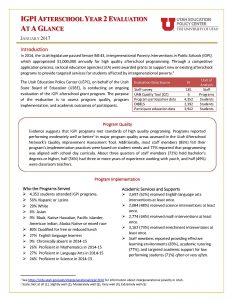
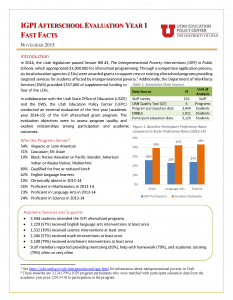
In partnership with the Utah State Board of Education and the Department of Workforce Services, the UEPC conducted an external evaluation of the Intergenerational Poverty Interventions (IGPI) in Public Schools grant program. Created by Senate Bill 43, the IGPI in public schools grant program appropriated $1,000,000 for programming. The evaluation objectives were to assess program quality and explore relationships among participation and academic outcomes.
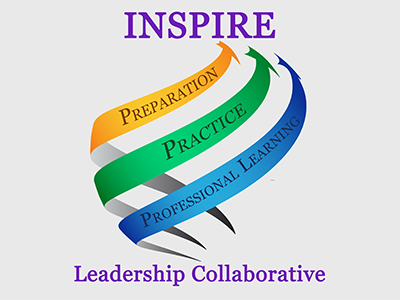
The purpose of this research brief is to report the findings of the 2017 administration of the INSPIRE-Leaders in Practice (LP) survey to school principals. This survey administration is part of a comprehensive research endeavor by the University Council for Educational Administration to more effectively evaluate leader preparation programs and their resultant outcomes.
This research brief presents the findings from the 2017 INSPIRE Graduate (G) Survey, administered by the University Council for Educational Administration (UCEA) to a national sample of recent graduates from educational leadership preparation programs. The survey sought to assess program quality and graduates’ self-reported learning in leadership domains.
In partnership with the Utah State Board of Education and the Department of Workforce Services, the UEPC conducted an external evaluation of the Intergenerational Poverty Interventions (IGPI) in Public Schools grant program. Created by Senate Bill 43, the IGPI in public schools grant program appropriated $1,000,000 for programming. The evaluation objectives were to assess program quality and explore relationships among participation and academic outcomes.
This research brief focuses on the findings from the INSPIRE-Preparation Program (PP) Edition of the INSPIRE Leadership Survey Suite. The INSPIRE Suite provides valuable data on leadership preparation programs and their outcomes, offering insights into the quality and structure of educational leadership preparation at UCEA member institutions. The survey highlights various aspects of program implementation, including partnerships with K-12 districts, candidate selection processes, curriculum design, candidate assessment methods, and fieldwork opportunities.
This research brief reports the findings from the 2016 administration of the INSPIRE Graduate Edition (INSPIRE-G) survey, which gathers data from recent graduates of educational leadership programs. The survey provides insight into graduates' demographics, professional backgrounds, career intentions, and assessments of their leadership preparation program’s quality, as well as their learning outcomes related to national leadership standards.
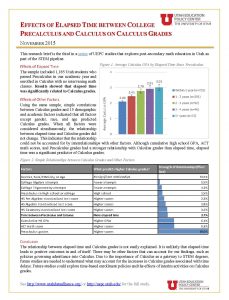
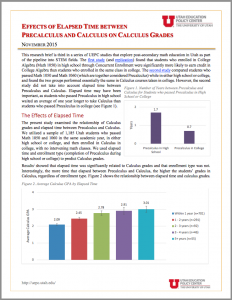
As a follow up to our Math 1050: College Algebra study, the UEPC analyzed data from the Utah Data Alliance to compare math outcomes for 593 students who took Math 1050 and Math 1060 (Precalculus) through concurrent enrollment while in high school to math outcomes for 592 students who took Math 1050 and Math 1060 through regular enrollment while in college.
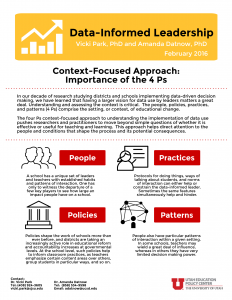
Vicki Park (San Jose State University) and Amanda Datnow (University of California, San Diego) summarize a decade of research on data-driven decision making in districts and schools. They introduce a framework that focuses on the people, policies, practices, and patterns (i.e., four Ps) within data-driven decision making.
The UEPC was contracted by the cities of Holladay City, South Salt Lake City, and Salt Lake County to conduct a study of issues related to school district governance. This report was commissioned by the inter-local group to inform their decisions about whether to divide Granite School District.
In response to the Utah Legislature Executive Appropriations Committee Request for Proposal in 2006, the UEPC conducted a study of charter schools in Utah to obtain information about the purpose, authorization, governance, and training associated with charter schools, as well as information about parents’ decisions to enroll in or withdraw their students from charter schools.
Categories
- Arts Education
- Assessments
- Charter Schools
- Chronic Absenteeism
- Dual Language/Multilingual Learners
- Early Childhood Education
- Education Policy
- Instruction
- Leadership
- Literacy/Reading Programs
- Other
- Out-of-School Time
- Postsecondary Education and Pathways
- Special Education
- STEM Education
- Teacher and Leader Preparation and Pipeline
- Teacher and Leader Professional Learning
- Technology Enabled Instruction
Featured Reports
Report Archive
- November 2006 (1)
- February 2007 (1)
- July 2007 (1)
- February 2008 (1)
- February 2009 (1)
- January 2009 (1)
- February 2010 (2)
- February 2011 (2)
- November 2011 (1)
- February 2012 (2)
- July 2012 (2)
- March 2012 (1)
- December 2013 (1)
- February 2013 (3)
- December 2014 (1)
- February 2014 (8)
- July 2014 (1)
- March 2014 (1)
- February 2015 (11)
- March 2015 (1)
- April 2016 (2)
- February 2016 (6)
- November 2016 (2)
- October 2016 (2)
- August 2017 (1)
- December 2017 (1)
- February 2017 (4)
- January 2017 (3)
- July 2017 (1)
- June 2017 (1)
- April 2018 (1)
- February 2018 (8)
- June 2018 (1)
- March 2018 (1)
- May 2018 (2)
- April 2019 (1)
- March 2019 (1)
- October 2019 (1)
- August 2020 (2)
- December 2020 (2)
- July 2020 (4)
- June 2020 (3)
- November 2020 (2)
- April 2022 (2)
- December 2022 (2)
- November 2022 (5)
- September 2022 (1)
- August 2023 (1)
- February 2023 (1)
- January 2023 (1)
- November 2023 (2)
- September 2023 (3)
- August 2024 (1)
- December 2024 (1)
- January 2024 (1)
- July 2024 (1)
- June 2024 (2)
- March 2024 (2)
- November 2024 (1)
- October 2024 (1)
- September 2024 (2)
- January 2025 (0)
- February 2025 (1)
- May 2025 (1)
- March 2025 (1)
- August 2025 (6)
- October 2025 (2)
- November 2025 (2)
- December 2025 (1)
- January 2026 (1)
- April 2026 (1)
- August 2026 (1)